
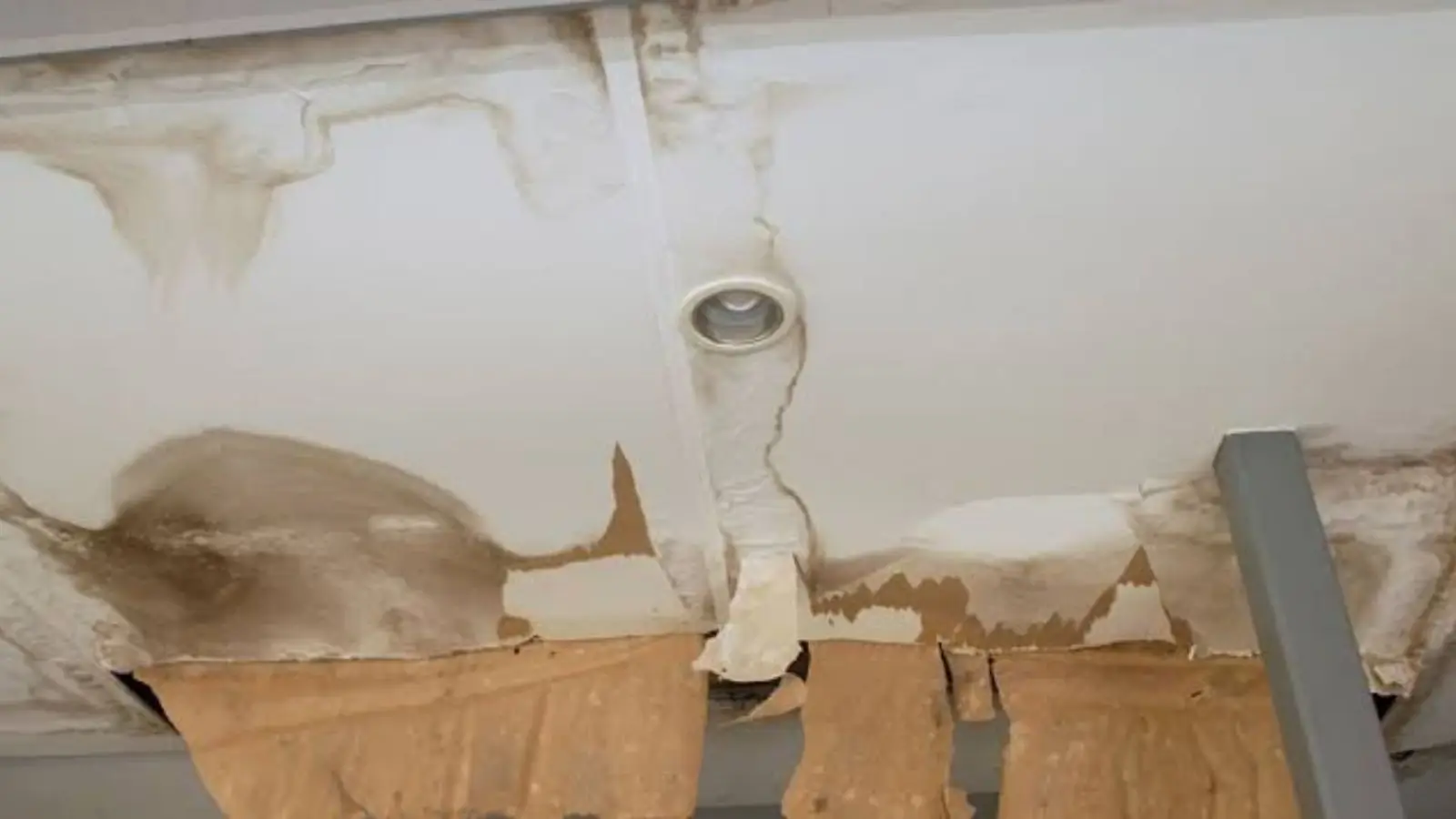
Fix the ceiling in this order
Stay clear of a sagging ceiling, shut off power to the area if it is safe to reach the panel, find and stop the water source, dry everything, cut out the drywall that failed, then patch or replace. Painting over a stain before those steps is the most common mistake, and the stain usually bleeds back while moisture remains.
Whether you can do the repair yourself depends on how wet and how big the damage is. A small, dry stain from a leak that is now fixed is a paint job. A bulging or sagging ceiling is a job for a crew, because it holds trapped water and can come down.
Safety first
A bulging, sagging or dripping ceiling can collapse without warning, and the water in it can reach light fixtures and wiring. Keep people and pets out from under it. Do not turn on ceiling lights or fans. If you see sparks or smell burning, or a fixture is wet, call 911 before calling us.
Find and stop the source
Water on a ceiling comes from above. The usual suspects are a leaking toilet, tub or supply line on the floor above, a roof leak, or condensation in the attic. A stain right under a bathroom points one way, and a stain along an exterior wall after a storm points another.
If the source is plumbing, close the fixture shut-off or the main valve. If it is the roof, a tarp helps until repairs are made. Condensation is trickier: look for wet insulation, frost on the roof deck in winter or exhaust fans venting into the attic instead of outside.
Relieve trapped water carefully
If the ceiling is bulging with water, a small hole at the lowest point lets it drain into a bucket. Wear eye protection and stand to the side. This is a judgment call, not a requirement. If you are unsure or the ceiling is large, leave it and call.
Move furniture out or cover it. Photograph everything before you cut or clean, since you may want it for an insurance claim. Our emergency water removal page explains how crews pull standing water out when a ceiling has already dropped it on the floor.
Water coming through the ceiling?
Call (385) 988-9410. Calls are answered 24/7, with same-day response when available.
Stain, bubble, sag or collapse: what to do
Match what you see to the likely path. A restoration pro should confirm anything past the first row.
| What you see | What it means | Typical path |
|---|---|---|
| Dry stain only | Past leak, now stopped | Confirm dryness with a meter, stain-blocking primer, repaint |
| Bubbling or peeling paint | Moisture in or on the drywall | Find the source, dry, cut out loose material, patch |
| Sagging or soft drywall | Material has lost strength and may hold water | Stay clear, relieve water, remove the section, dry the cavity |
| Collapsed section | Heavy saturation, possible insulation and debris | Call a crew, treat debris with care, remove and dry, then replace |
Large areas, wet insulation, or anything involving sewage or electrical fixtures should be handled by professionals.
Dry the space before you close it up
Drywall and insulation hold water long after the surface looks fine. EPA guidance says to dry wet materials within 24 to 48 hours to prevent mold growth, so speed matters. Open the damaged area, remove wet insulation and let air move through the cavity.
Professionals use air movers, dehumidifiers and moisture meters to confirm the wood framing and drywall are dry before anything is patched. A thermal camera helps find wet areas that look normal. Our water mitigation service page covers that process in more detail.
The published ANSI/IICRC S500 standard for water damage restoration expects drying to be confirmed with moisture readings, not by how the surface looks or feels.
What to cut out and what to keep
Cut back to dry, solid material, and not just the edge of the stain.
Ceiling removal checklist
- Soft or sagging drywall. Remove it fully. It will not regain strength.
- Wet insulation. Take it out and dry the cavity. Wet insulation holds water against the framing.
- Stained but firm, dry drywall. Often stays. Confirm dry with a meter.
- Joists and framing. Dry in place. Let a pro measure them against a dry reference.
- Anything near fixtures. Have a licensed electrician check wet fixtures before use.
Patch or replace, and primer or new drywall
Small holes and small damaged sections can be patched with new drywall cut to fit, taped and mudded. Larger areas are easier to replace as full sheets, so seams and texture match. A patch that is dry, well finished and sealed looks better than a bigger repair done badly.
Stain-blocking primer is right for a dry, firm ceiling with a cosmetic mark. It is not right for soft drywall, wet material or an unfixed leak. If a stain bleeds through after priming, the ceiling is probably still damp. For the full rebuild stage, see our water damage repair page.
Snow load and freeze-thaw in Payson
NOAA 1991-2020 normals for nearby stations show about 66 inches of snow a year at the Spanish Fork Power House station and about 55 inches at the Santaquin Chlorinator station. There is no Payson-named station, so these are neighbors, not exact numbers.
For ceilings, snow on the roof that melts and refreezes can push water under shingles or into attic spaces. A stain after a thaw is a reason to check the roof edges and attic insulation, since melt-driven leaks often show up on a ceiling far from the roof edge.
Source type: NOAA National Centers for Environmental Information climate normals, 1991-2020When to call a professional
Call when the ceiling is sagging or collapsed, when the damage covers more than one room, when insulation is soaked, or when you cannot find the source. Call too if the water came from a toilet or drain, since that water is not clean.
Neighbors in Spanish Fork and Salem get the same snow and storm patterns as Payson, so the same roof and attic checks apply.
Frequently asked questions
Only after the leak is fixed and the ceiling is fully dry. Use a stain-blocking primer, then paint. If the stain returns, moisture is still present.
Yes. It can hold a lot of water and fall. Stay out from under it and keep power off to nearby fixtures if you can do so safely.
Often yes if it was soaked. Wet insulation holds moisture against framing. A moisture meter helps decide what can stay.
It can if materials stay wet. EPA guidance says to dry wet materials within 24 to 48 hours. Mold needs moisture, so fix the leak first.
Ask the Building Division at Payson City Development Services whether your repair needs a permit.
Yes, melt and refreeze at roof edges can push water into attics, and nearby NOAA stations record 55 to 66 inches of snow a year. A stain after a thaw is worth tracing back to the roof.
Need the ceiling dried and repaired?
Call (385) 988-9410. We explain scope and price before work starts.