
The short answer on drying time
Drying often takes several days, and it runs longer for dense materials such as hardwood or plaster. There is no honest single number, because the water category, the materials, the size of the area and the conditions inside the house all change the clock. A crew decides it is done from readings, not from a guess.
The best way to shorten drying is to start early. EPA guidance says to dry wet materials within 24 to 48 hours, because after that mold becomes a concern. Our water mitigation page describes how that starts.
What controls how long drying takes
Each factor pushes drying time up or down. Several usually act at once.
| Factor | Effect on drying | What you can do |
|---|---|---|
| Water category (1, 2, 3) | Category 2 and 3 water means more material removal before drying starts | Call early and keep people out of contaminated areas |
| Class of loss (1 to 4) | Higher class means more wet surface and deeper absorption | Report every wet area, even small ones |
| Materials | Hardwood, plaster and dense framing release moisture slowly. Carpet and drywall dry faster or are removed | Do not paint or seal wet surfaces |
| Area affected | More wet area needs more equipment and more days | Photograph and describe each room |
| Humidity and temperature | Moist or cold air holds less drying capacity | Keep the structure closed and the heat on |
| Ventilation and airflow | Closed containment dries faster than a house open to outside air | Keep doors and windows shut near the drying area |
| Equipment placement | Poorly placed air movers leave wet pockets | Leave the setup where the crew put it |
Time is a range, not a promise. A crew explains the scope and the estimated drying days before work starts.
What the equipment actually does
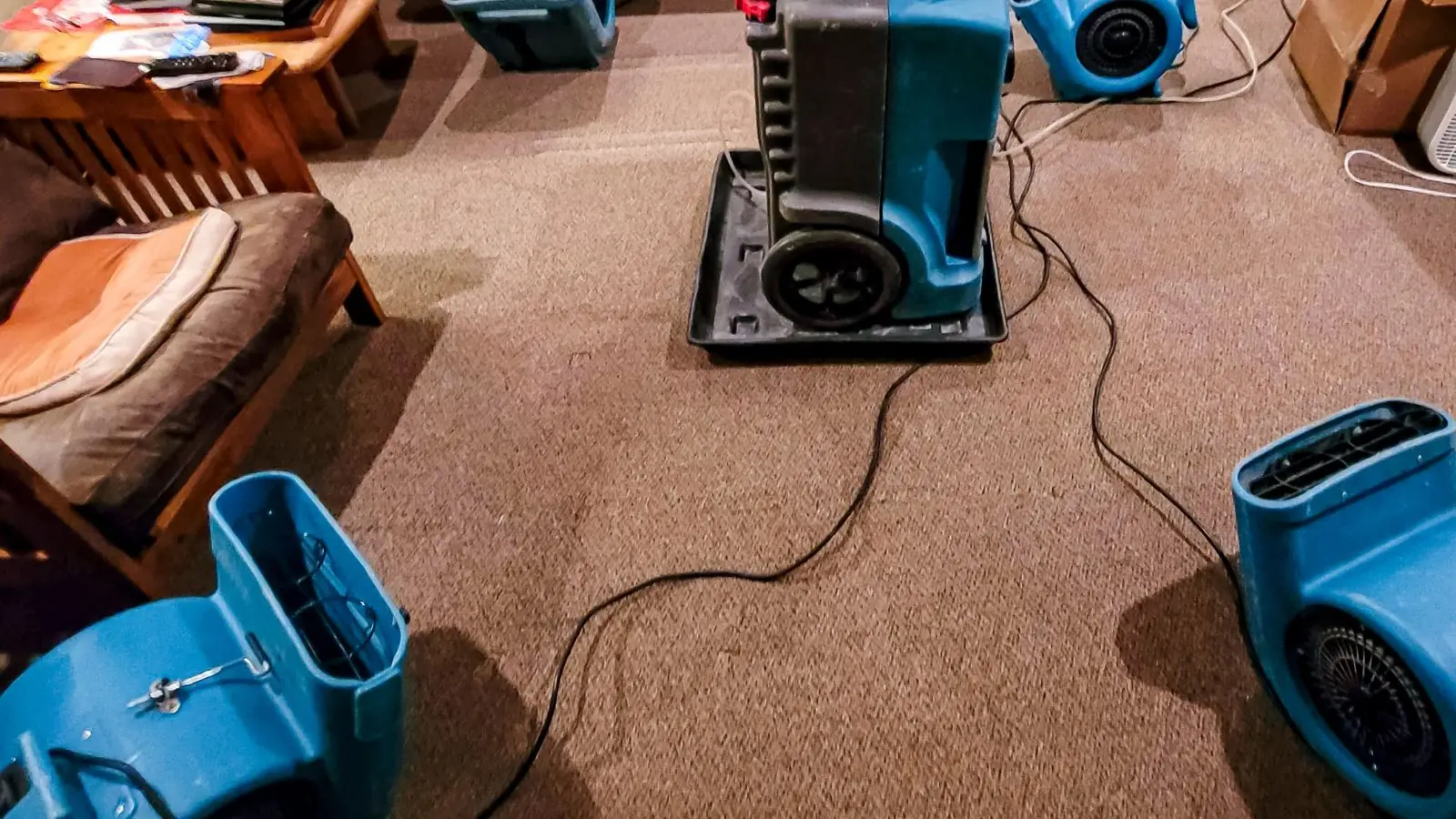
Air movers push dry air across wet surfaces and pull moisture into the air. Dehumidifiers remove that moisture. LGR dehumidifiers work well in warm, moist conditions, and desiccant dehumidifiers work better in cooler or very wet conditions. Together they dry the air and the materials at the same time.
Moisture meters read how wet a surface or material is. Thermal imaging cameras show cool, wet areas behind a finished wall without opening it. Containment, usually plastic sheeting, keeps the drying zone separate from the rest of the home so the equipment is not fighting the whole house.
How drying is monitored and when it is finished
The ANSI/IICRC S500 standard calls for drying toward a dry reference. A crew takes readings in an unaffected area of the same material, then dries the wet material until its readings come down to that reference. Readings are logged each visit.
This is why a moisture log matters. It shows what was wet, what was removed and when each material reached its target. It is also useful documentation for your insurance claim.
Do not shut the equipment off early
Turning air movers and dehumidifiers off because they are loud or because a wall feels dry can trap moisture behind the surface. Wet framing and insulation can stay damp for days after the surface feels fine, and that is where mold starts. Ask the crew lead before moving or unplugging anything.
Not sure if it is drying right?
Call (385) 988-9410 and describe what you see. A crew lead explains the next steps, and scope and price are explained before work starts.
What homeowners can do during drying
A few habits keep the job on track.
Help the drying along
- Keep doors closed. Closed doors keep the drying zone controlled. Opening the room lets humid air in.
- Leave equipment running. It uses a lot of power. That is normal and part of the job.
- Keep the heat on. Warm air holds more moisture than cold air, which speeds drying.
- Keep records. Save receipts for temporary repairs and keep photos, readings and a call log.
- Don't repair too soon. Do not close up walls or lay new flooring until readings say the structure is dry.
Payson's dry climate and what it means indoors
NOAA's 1991-2020 normals show about 20.2 inches of precipitation and 66 inches of snowfall a year at the Spanish Fork Power House station, and 18.4 inches and 55 inches at Santaquin Chlorinator. Those are nearby-station figures, not Payson readings, and they describe a high-desert valley with mountain snow.
Dry outdoor air helps, but it does not dry a flooded room. Once a loss happens, the room is a closed space where humidity stays high until equipment removes it. Do not open windows hoping the outdoor air will finish the job, because that works against containment.
Source type: NOAA NCEI climate normals for nearby stationsWhen drying runs longer than expected
If readings stall, the crew looks for a hidden source, wet insulation, trapped moisture under flooring or a part of the wall that the airflow does not reach. Sometimes materials that looked salvageable need to come out. That is normal, and it is better than closing up a wet wall.
Carpet and some flooring are often removed rather than dried in place, which speeds the rest of the job. If you want to understand the cleanup side, water damage cleanup covers what is removed and what is saved.
Drying in neighboring towns
Homes in Spanish Fork and Salem sit in the same valley and follow the same process. The materials and the scope change the answer more than the town does.
Drying time questions
Often several days, longer for dense materials such as hardwood or plaster. The exact time depends on the water category, materials and area.
A crew gives a range after inspecting and keeps adjusting from daily readings.
Readings from a moisture meter come down to the dry reference for each material, per the S500 standard. Crews log this.
A wall that feels dry may not be, which is why meters and thermal imaging matter.
Ask the crew lead first. Turning dehumidifiers or air movers off for long can slow drying and let moisture settle back in.
If noise or power is a problem, tell the crew so they can adjust the setup.
Dry air outside helps in principle, but after a loss the room is a closed space where indoor humidity stays high until equipment removes it.
Keep windows and doors closed and let dehumidifiers do their job.
Hardwood is dense and absorbs water slowly, so it also releases it slowly. Carpet and pad are usually removed after a serious loss.
Hardwood often needs specialty drying mats and several days of readings.
Mold needs moisture, so wet materials left wet are the risk. EPA guidance says to dry within 24 to 48 hours.
If you see mold, tell the crew. Remediation follows S520, and health questions belong with a physician.
Want your real drying plan?
Want your real number? Call (385) 988-9410 and describe the water. The scope and price are explained before work starts.